



By Friar Enrique Eguiarte, OAR
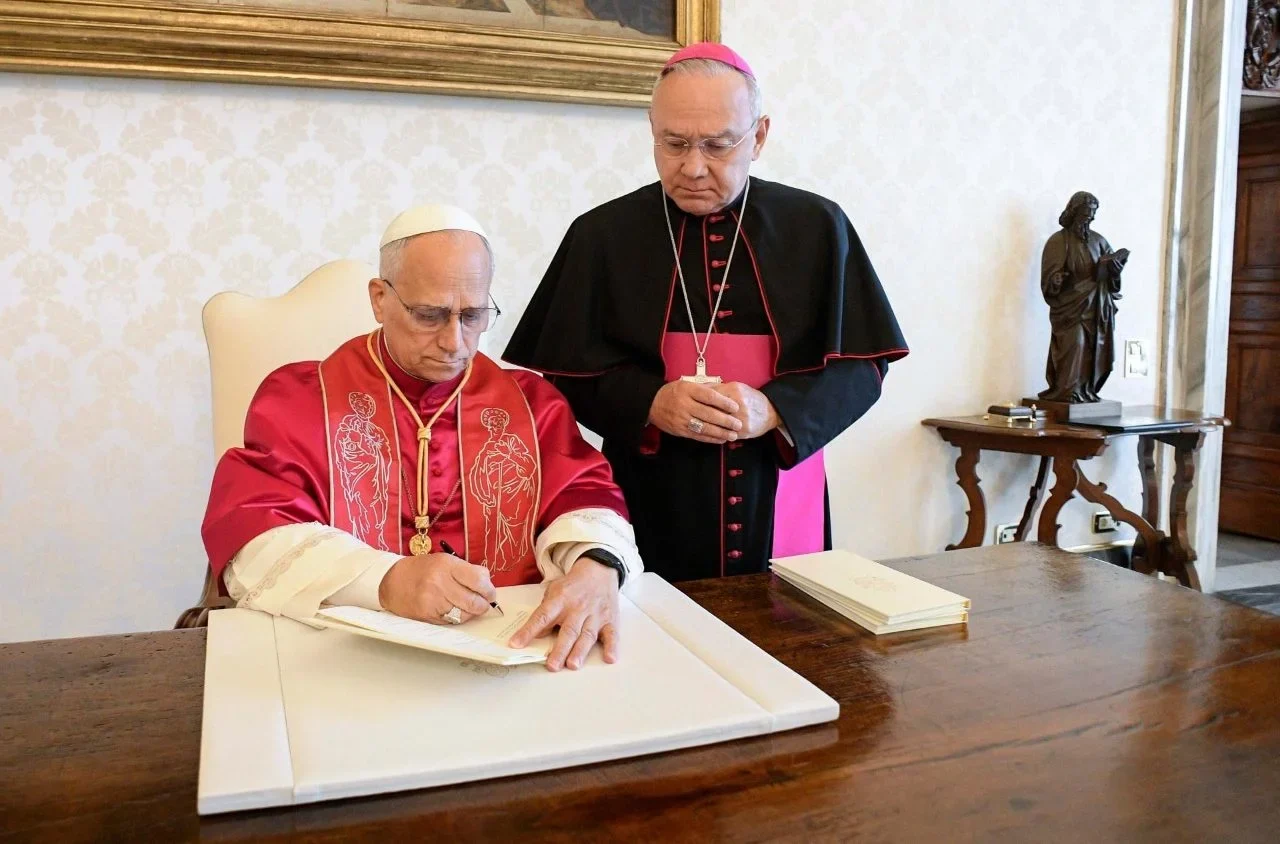
Pope Leo XIV signed on October 4, 2025 the first apostolic exhortation of his pontificate, entitled Dilexi te(“I have loved you”), presented today in the Sala Stampa of the Holy See at 12:00 noon. This text – which could be considered the
programmatic document for a pontificate with an Augustinian heart
– is also the
first apostolic exhortation of Pope Leo XIV, taking up a work begun by Pope Leo XIV.
It is also the first apostolic exhortation of Pope Leo XIV, taking up a work begun by Pope Francis in the last months of his life.
Just as Francis completed Benedict XVI’s encyclical Lumen Fidei in 2013, Leo XIV now picks up on the intuitions of his predecessor, offering a
spiritual and pastoral continuation of the encyclical Dilexit nos on the Heart of Jesus.
on the Heart of Jesus. In Dilexi te, the new Pope clearly denounces “the economy that kills,” structural inequity, violence against women, malnutrition, the educational crisis and the abandonment of migrants.
The Pope insists that structures of injustice must be destroyed with the power of goodness.and stresses that in the wounded face of the poor, “we find imprinted the suffering of the innocent “we find imprinted the suffering of the innocent and therefore the suffering of Christ himself” (n. 9). (n. 9).
It also reaffirms the “preferential option for the poor,” born in Latin America, as an expression of God’s compassion for all of humanity.
God’s compassion for all of humanity, and not as discrimination.
and not as discrimination. “Through the poor – the Pope writes – God continues to have something to say to us”.
Enrique Eguiarte, Augustinian Recollect, professor, researcher and expert on St. Augustine,
he unpacks the Augustinian keys of the apostolic exhortation, highlighting the quotations of the saint of Hippo
He highlights the quotations of the saint of Hippo that illuminate the document with spiritual depth and ecclesial commitment.
Augustinian quotations in the Exhortation Dilexi te
Not only does the new apostolic exhortation Dilexi te dedicate a special section to St. Augustine, but it also provides us with three Augustinian quotations. Two of them come from authentic works and a third one is taken from a pseudo-Augustinian sermon, that is to say, not authentic from the Hipponesian.
At St. Ambrose’s school
St. Augustine is mentioned in relation, in the first place, to his mentor St. Ambrose, for whom charity and almsgiving were not only an act of benevolence, but of justice, since one possesses the goods of others when one has an abundance of material goods, since God has created all things for the benefit of all men and it is necessary to be aware that we are simply administrators of these goods. The Ambrosian quotation is the following, taken from his work De Nabuthae:
“What you give to the poor is not yours, it is his. For you have appropriated what was given for common use.”
In and beyond the Body of Christ
St. Augustine was formed in this Ambrosian school, and in the year 406, in the Enarratio to Psalm 125, he commented in an ecclesial sense on how the poor become a “sacramental” presence of Christ himself. In this Enarratio, St. Augustine presents, as in many others, the ecclesial sense of Christian life: we are members of the Body of Christ, and we cannot ignore those who are part of this mystical body.
For this reason, he exhorts us to attend to the poor of this Body of Christ. However, St. Augustine does not stop there, and invites his faithful to pay attention to the poor outside the ecclesial body as well.
charity has no frontiers
and that the love of Christ is universal, without exclusion.
The text that impressed Saint Augustine
The second Augustinian quotation is taken from Sermon 86:5, preached towards the end of the life of the Bishop of Hippo (429-430). Although he comments on the passage of the rich young man, Augustine returns to one of the Gospel texts that moved him most: Mt 25:31-46. Already in Sermon 389:5 he had said that this text impressed him very much, and he invited his faithful to let themselves be touched by it.
Augustine puts on the lips of Christ a paraphrase of this gospel with an eschatological sense:
“I received earth and will give heaven. I received temporal things and I will give eternal goods in return. I received bread, I will give life. [I have received lodging, and I will give a house. I have been visited in sickness and I will give health. I was visited in prison and I will give freedom. The bread that was given to my poor was consumed; the bread that I will give restores strength, never running out”.
The purifying meaning of almsgiving
The third quote is from a
pseudo-Augustinian sermon
and emphasizes the healing and purifying character of almsgiving. In his authentic sermons, especially those addressed to the competent during Lent, Augustine already spoke of almsgiving as a means to
purifying sins
as a complement to the penitential journey.
It is curious that an unauthentic text has been quoted, when there are other valid texts, such as Sermon 210,9 or Sermon 58,10, where it says:
“He shall have two wings: the double alms. What is the double alms? Forgive, and it shall be forgiven you; give, and it shall be given to you.”
Institutional charity with an Augustinian face
It is significant that the Pope dedicated a specific space to St. Augustine, even though his contribution to the world of charity cannot be summarized in a few lines. Augustine was an innovator:
he founded the first known diocesan Caritas
(Ep. 20*,2) and he created
the second Christian hospital in history
(cf. Sermon 356,10).
The patristic authors, rather than making a theological and ecclesiological reflection, lived and experienced some of the essential features of what today we call sacramental communion and communion in charity. The Churches in the first centuries recognized themselves as living the same sacraments in Christ, and as part of the same body, and in him they were linked by the bond of charity. Some writers of the first Christian century, such as Ignatius of Antioch, designate the Church of Rome as that which presides over the other Churches not by hierarchical elements, but presides over them in charity. This was the experience of the primitive communities, to recognize themselves living in a communion or communion in the liturgical and sacred elements (the sacraments) and in the love that overcomes the accidental differences and highlights the essential that unites.