



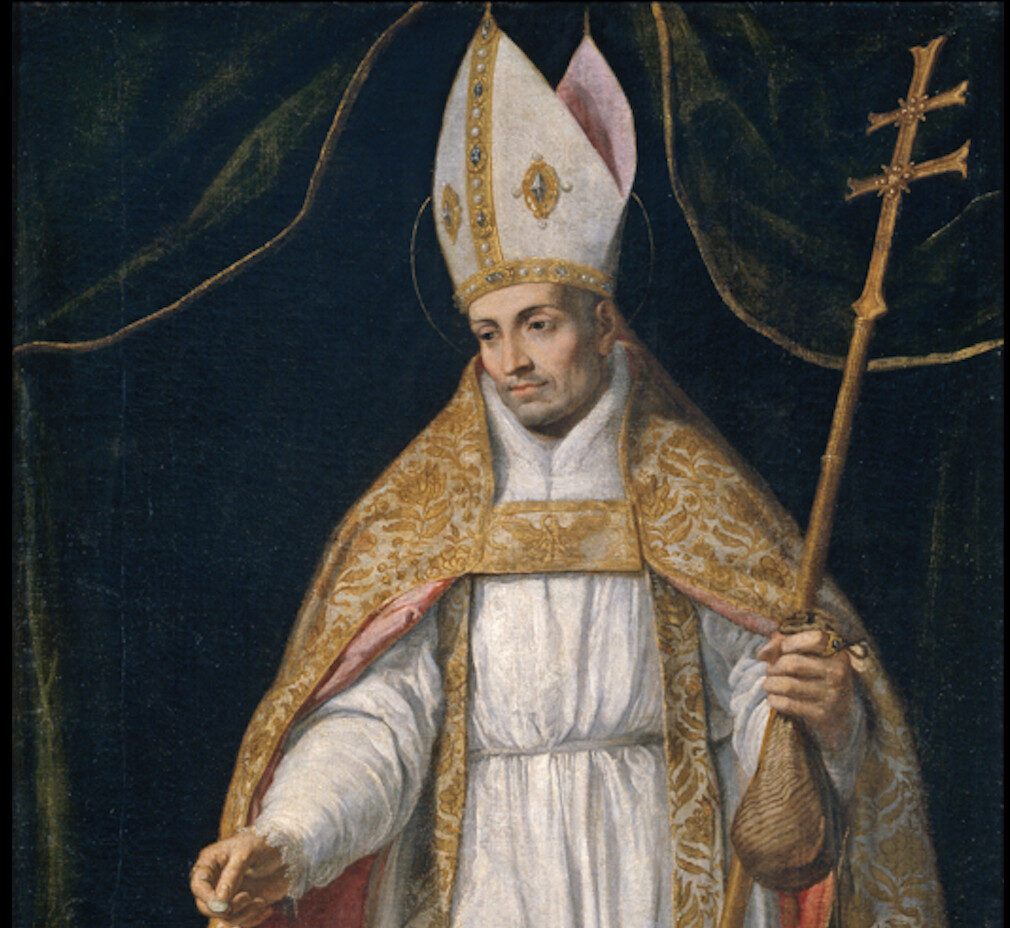
St. Thomas of Villanova (1486-1555) is remembered as one of the great models of the Augustinian Family, outstanding for his profound charity and generosity. He was born in Fuenllana, a small town in the province of Ciudad Real (Spain). His childhood was marked by the example of his parents and teachers in compassion towards the needy. In fact, since he was a child he showed a detached heart: more than once he returned home without clothes because he had given them to the poor he found, despite the fact that his family was well-to-do. This early sensitivity to the underprivileged eventually earned him the nicknames “Almsgiver of God” and “Archbishop of the Poor,” reflecting the mission of service that would define his entire life .
Vocation and life as an Augustinian friar
Thomas studied arts and theology at the University of Alcala, where he obtained a solid humanistic formation. However, feeling the religious call, he entered the Augustinian convent of Salamanca in 1516 and professed his vows as a friar on November 25, 1517. He was ordained a priest the following year and soon began to carry out important responsibilities within the Order: he was successively master, prior of his convent, visitator general and even prior provincial in the Augustinian provinces of Andalusia and Castile. Those who knew him during this period emphasize his commitment to community life and the observance of the Rule, combining great practical intelligence with humility and deep spirituality.
His lifestyle as a friar was austere to the extreme. It is said that he sold the humble straw mattress in which he slept in order to obtain money to give to the needy. No personal luxuries: Thomas embodied the Augustinian ideal of living with evangelical simplicity. At the same time, he preached with fervor and clarity, achieving fame as a great sacred orator. Emperor Charles V himself, who attended his sermons, exclaimed in admiration:
Friar Thomas’ dedication transcended frontiers. In 1533, during his service as provincial, he sent the first Augustinian missionaries to the New World, dispatching a group of friars to Mexico to bring the Gospel there. This decision made him a pioneer of the Augustinian mission in America, demonstrating his apostolic zeal and universal vision of charity. He was also named confessor and spiritual advisor to Emperor Charles I of Spain and V of Germany, a position from which he maintained his simplicity, knowing that he was confessing to the most powerful man in Christendom.
Archbishop of Valencia and “Father of the poor”.
In 1544, Tomás’ reputation for holiness and wisdom led Charles V to propose him as archbishop of Valencia, a diocese that had been without a resident pastor for more than a century. Thomas, true to his humility, initially resisted with all his might to accept such a dignity, even begging to be excused. Only when his religious superiors ordained him under holy obedience did he agree to assume the episcopal office. Even then, he remained faithful to his austere spirit: tradition has it that he
Upon taking possession of the archdiocese, Tomás de Villanueva’s priority was to care for the poorest and to reform the life of the clergy and the people. He found a diocese with great material and spiritual challenges, and he set out to revitalize it on all fronts. He renounced any personal benefit from his position: when the notables of Valencia offered him the traditional welcome gift – some 4,000 silver coins –the new archbishop gave them all to the hospitals and charities, declaring that “the poor need this more than I. What luxuries and comforts can a simple friar like me need?”. This initial gesture set the tone for his pastoral government.
As archbishop, Thomas continued to live practically as a friar and turned the bishop’s palace into a haven of charity. Every day, hundreds of needy people came to the doors of his house, and he had given orders that no one should leave empty-handed. He distributed food, clothes, money, medicine, whatever was needed. He had special compassion for the most vulnerable groups: he
Thomas preached by example and by word. In his sermons, he relentlessly exhorted active mercy. “If you want God to hear your prayers, listen to the voice of the poor,” he cried, “if you want God to anticipate your desires, provide for the needy without waiting for them to ask. Anticipate the needs of those who are ashamed to beg…To make them beg is to make them buy it.” With this clear language he taught that true religion implied social justice and concrete compassion. Even in the face of those who criticized him for “giving too much” or for indiscriminately helping vagrants, St. Thomas replied that
Generosity until the end of his days
The life of St. Thomas of Villanova was coherent until the end. In September 1555, feeling the hour of his death approaching, he suffered a severe angina pectoris. Faithful to his convictions of total detachment, he immediately ordered that all the alms and money left in his house be distributed among the poor. He did not want to leave anything that was his own, even in those last moments. In fact, tradition points out a shocking and significant detail: Thomas no longer even had his own bed in which to die, since the only bed he used had been given to a needy person before he died. Thus the Gospel ideal of radical poverty was literally fulfilled in him. The saint went so far as to say to those around him:
A 17th century oil painting depicts St. Thomas of Villanova as archbishop distributing alms. He carries a bag of money in his hand, a symbol of the charity he tirelessly practiced with the poorest.
According to his biographers, in his last moments Thomas asked that Holy Mass be celebrated in his room. At the end of the Eucharist, he exclaimed with peace and joy:
The imprint of St. Thomas of Villanova lasted long after his death. His example as a