



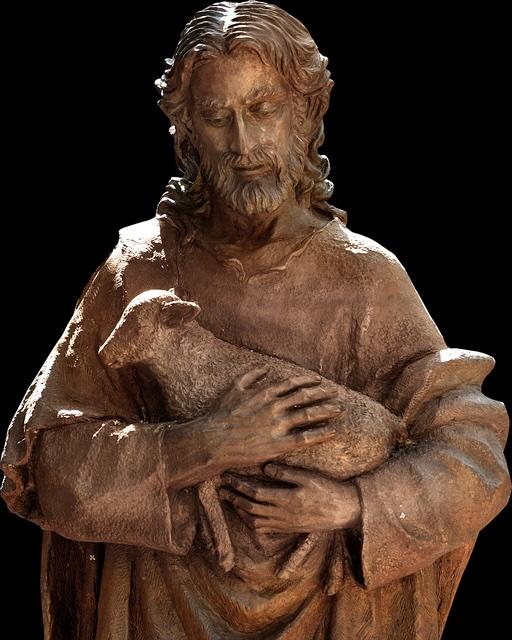
In this commentary on the Gospel, Friar Luciano Audisio invites us to contemplate God’s mercy as a love that erases all distance. Jesus sits at table with sinners, searches for the lost sheep and lights the lamp to find the lost coin. God does not tire: he tirelessly searches for us, and when he finds us, he does so with tenderness and celebration.
A God who always forgives
This Sunday’s Gospel speaks to us of God’s mercy. And the first question that arises is: Does Jesus always forgive us? The answer is clear: yes. Precisely when we believe that there is no more forgiveness possible, when we feel that the distance with God is too great, at that moment He comes to meet us to embrace us.
The table of sinners
The Gospel begins with a very simple image, but loaded with meaning:
“The tax collectors and sinners came to Jesus to listen to him” (Lk 15:1).
It is beautiful: those who feel far away are those who begin to draw closer. And this rapprochement is born of a driving force: the Word of God. That Word that touches the heart, that fills the distance, that opens a bridge between a holy and mysterious God and us, who so often feel unworthy.
However, not everyone reacts in the same way. The scribes and Pharisees do not approach, but murmur. This verb, to murmur, is well known to us from the Exodus: the people murmured because they did not want to leave Egypt, because they were closed in on themselves. To murmur means to resist the way out, to resist the inner exodus that leads us to God.
And why do the Pharisees murmur? Because Jesus does something scandalous: he eats with sinners. In Israel, to share the table was the gesture of greatest intimacy, it meant to become one with the other, to enter into communion. To eat together was, in a way, to become one, to feed on the same bread.
That is what Jesus does with us: he sits at the sinner’s table to erase all distance. It is not by chance that, in Hebrew, the verb caphar (כפר) means to cover and also to forgive. To forgive is to cover the distance that separates us.
The lost sheep: a shepherd “mad” with love
To explain this love that erases distances, Jesus gives us two parables. The first is that of the lost sheep.
Humanly speaking, it seems crazy: no prudent shepherd would leave ninety-nine sheep to go after just one. But that is exactly the message: God is a shepherd “mad” with love, who risks everything because he is in love with the lost sheep.
And not only does he look for her: when he finds her, he puts her on his shoulders. This gesture expresses tenderness, contact, closeness.
“Faith is transmitted in this way, with contact, with presence. We ourselves are called to be ‘the shoulders of the Good Shepherd’ for our brothers and sisters, carrying them in community.”
The lost drachma: the psychology of God
The second parable is that of the lost drachma. Here Jesus shows us the “psychology” of God: like the woman who lights the lamp and searches endlessly until she finds her coin.
This image completes the previous one: the sheep is lost outside the house, the drachma is lost inside. Sometimes we get lost away from the Church, but sometimes we get lost inside it, in the midst of our routines and securities. And yet, inside or outside, God tirelessly searches for us.
Forgiveness Party
Today’s message is clear: God never tires of seeking us.
When we are afraid of not being forgiven, let us remember that He leaves the ninety-nine to come after us. That God is “crazy” with love for each one.
And the most beautiful thing of all is that, when he meets us, there is no reproach, no judgment, but celebration, joy and communion.
Conclusion
Let us ask today for the grace to allow ourselves to be found, not to shut ourselves up in murmurs or false assurances, but to allow the Word to touch our hearts and draw us closer to the embrace of Christ, the Good Shepherd.