



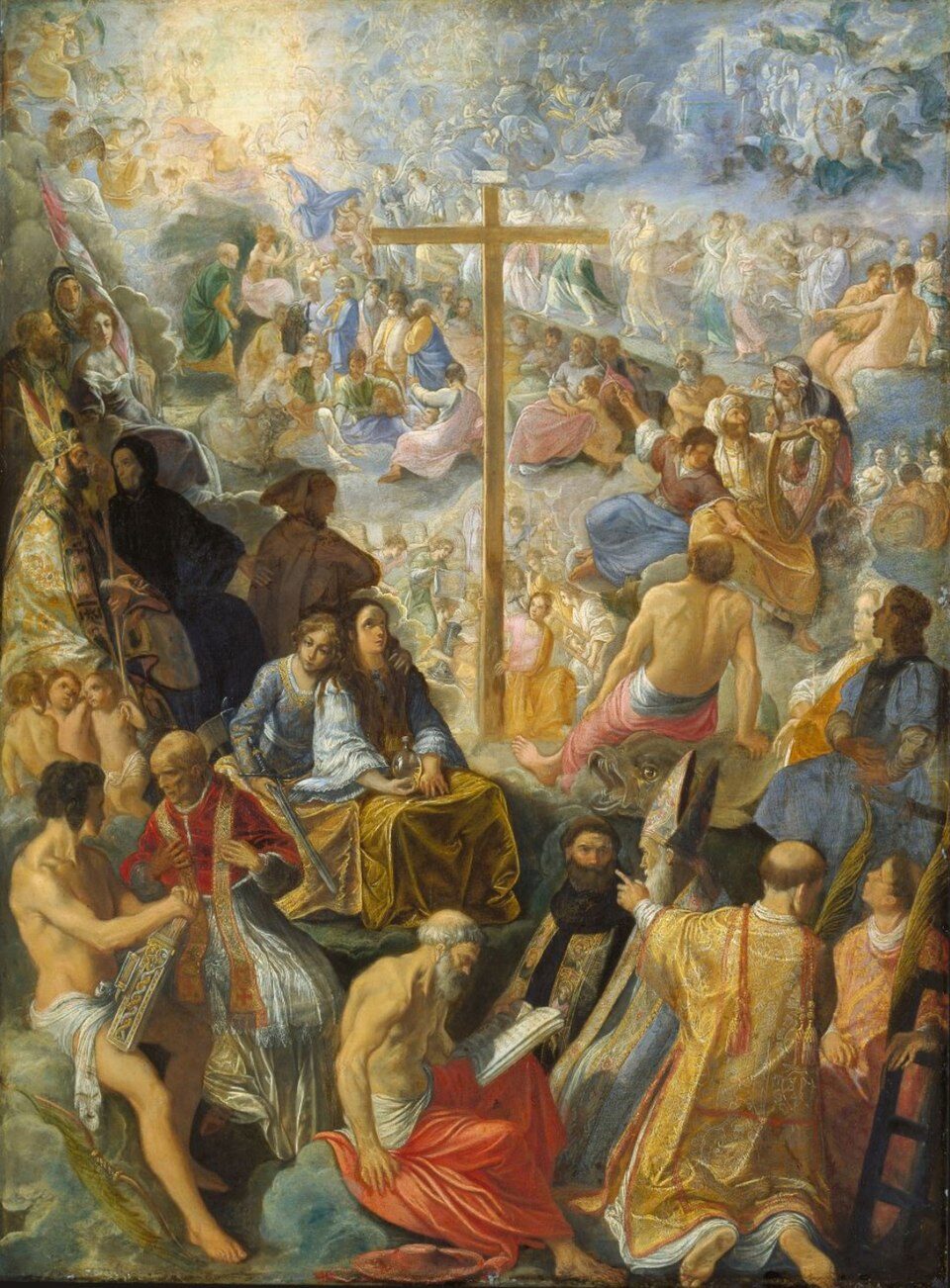
The celebration of the Exaltation of the Holy Cross is one of the oldest Christian festivals. This solemn event, commemorated on September 14, is honored by the Catholic Church as well as by various Protestant denominations and the Eastern Orthodox Church. It has deep roots in Christian history and carries a transcendental spiritual significance.
The origin of this venerable feast is intimately linked to a historical event of great importance: the finding of the true Cross of Jesus by St. Helena, mother of the Roman Emperor Constantine, in 320 AD. This event marked a turning point in the history of Christianity and laid the foundation for the celebration of the Exaltation of the Holy Cross.
The history of the Exaltation of the Holy Cross
At the beginning of the fourth century, St. Helena undertook a pilgrimage to Jerusalem with the fervent mission of identifying and preserving the sacred places related to the life of Christ. During this journey, she made a momentous decision: to order the demolition of the Temple of Venus, a structure dating back to the second century, which, according to tradition, was erected directly over the tomb of the Redeemer.
During excavations at the basilica, workers made an extraordinary discovery: three crosses. According to legend, the authentic Cross of Jesus was identified when, in a miraculous way, it touched a seriously ill woman, who was instantly healed. Subsequently, the Basilica of the Holy Sepulcher was erected on this sacred site at the initiative of Constantine in the year 335. This place became the epicenter of veneration for Christians around the world, housing the tomb of Christ and, now, the Cross on which he was crucified.
The discovery of the Cross marked a moment of profound spirituality and marked the beginning of the veneration of the Cross among the followers of the Christian faith.
As news of this discovery spread in the Holy City, crowds of the faithful gathered to pay homage to the Cross of the Lord. The Patriarch of Jerusalem, St. Macarius, placed the Cross in a pulpit. When the people saw it raised high, their voices joined in the cry of “Kyrie eleison” (Lord, have mercy). Today, this event is commemorated in the Exaltation liturgy, where the priest raises the Cross above the heads of the faithful, gives them his blessing and turns towards the four cardinal points, while the choir harmoniously intones “Kyrie eleison” one hundred times in each direction. Then, the faithful come forward to venerate the Cross and receive one of the flowers that decorate the place where the Cross is located. In the Eastern Churches, this celebration is so significant that it is often compared to an autumn Easter.
The celebration was introduced into the Western liturgical calendar in the 7th century, after Emperor Heraclius recovered the Cross from the Persians in 628, who had sacked it in 614, destroying the basilica, known as the Martyrium, and the sanctuary, known as Calvary. The Church of the Holy Sepulchre, which now stands on that sacred site, was erected by the Crusaders in 1149.
The profound meaning of the Exaltation of the Holy Cross
The Exaltation of the Holy Cross is a celebration deeply rooted in Christian history and spirituality. Originating in Jerusalem and extended to the Western world, it carries deep theological significance as a symbol of Christ’s victory and His call to follow Him in the daily vicissitudes of our lives. In addition, personal devotion to the Holy Cross can find expression in the ordinary moments of our existence, serving as a poignant reminder of the profound link between the Cross and our daily reality.
In the contemporary era, the Cross represents the universal emblem of the Christian faith. Over the centuries, countless generations of artists have turned it into an object of beauty, to be carried in procession or worn as jewelry. However, in the eyes of the early Christians, the Cross had no beauty whatsoever. It stood outside the city walls, adorned only with the decaying bodies of the damned, representing a threat to anyone who challenged Rome’s authority, including Christians who steadfastly refused to offer sacrifices to the Roman gods.
As a symbol of Christ’s victory and His call to follow His way in our daily lives, the Cross remains the universal icon of the Christian faith. Its importance throughout the centuries is a palpable reminder of the perseverance and devotion of the early Christians, and today, the Cross invites us to reflect on its significance in our daily lives. Its simplicity and power continue to be a shining beacon of hope for believers around the world.