



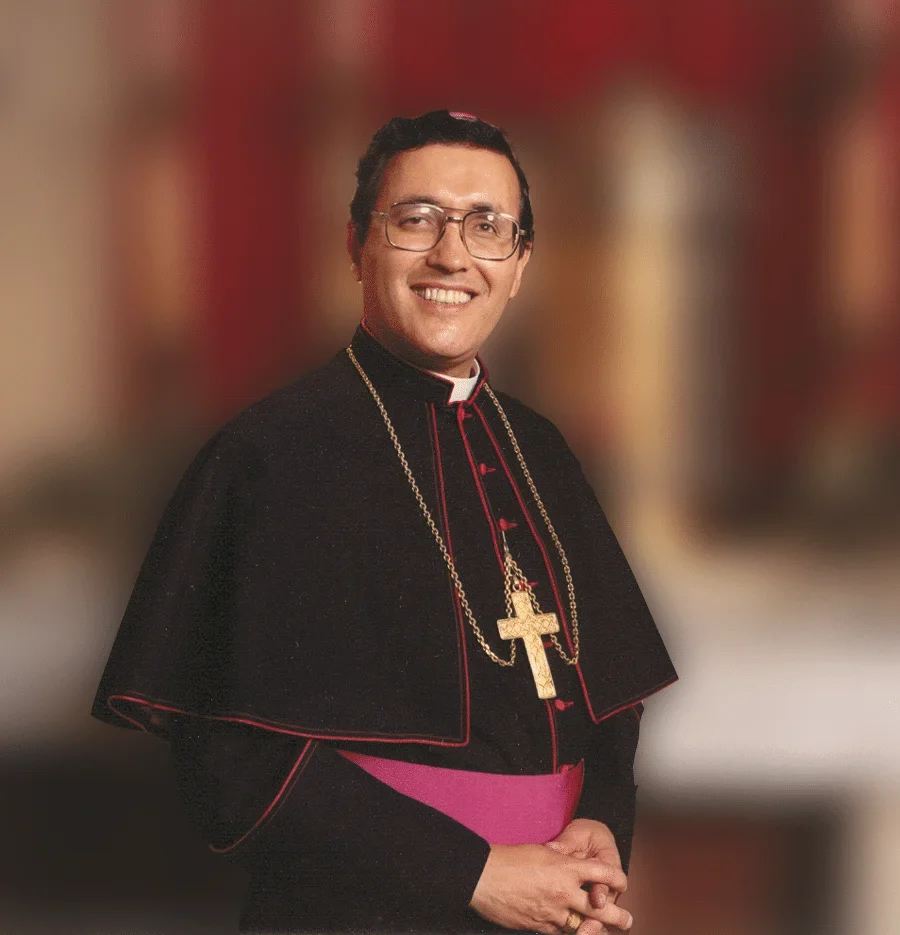
The scene seemed unusual: more than 300 lowrider cars were slowly moving in funeral procession through the streets of Sacramento. It happened in October 1991, when the community of modified car enthusiasts was bidding farewell to one of their own: Monsignor Alfonso Gallegos, who was affectionately called the ” lowriderbishop. Today, 34 years after his death, his memory lives on. Who was this bishop capable of winning the hearts of the youth of the barrios and of a subculture normally wary of authority? His story, marked by humility and closeness, is that of a pastor on the peripheries long before this term became fashionable in the Church.
I got to know Monsignor Gallegos thanks to Fray Eliseo, vice-postulator of his cause. During the years we lived together, he introduced me to the figure of a simple, human and close bishop. Msgr. Gallegos is not only a model of an interesting pastor, he is also a model of an Augustinian Recollect: a friar who walked with the people entrusted to him, without ever losing his smile. I remember Eliseo telling me with fraternal irony: “Gallegos had to be with the lowriders; you, among cameras and journalists”. Today, with deep admiration, I want to introduce you to a model of holiness that convinces me. I hope he can help you too.
Childhood of faith and persevering vocation
Alfonso Gallegos Apodaca was born on February 20, 1931 in Albuquerque, New Mexico, into a humble and deeply pious family with eleven children. As a child, he faced a severe visual disability -almost total myopia- that left him on the verge of lifelong blindness. However, that limitation did not erase the radiant smile that would characterize his face. When he was still young, his family moved to the Watts neighborhood of Los Angeles, where the Augustinian Recollect friars of St. Michael Parish nurtured in him the religious vocation he had felt since he was an altar boy. Although his eyesight problem caused many to doubt his capacity for ministry – he could barely read without great effort – Alfonso did not give up. With tenacity and trust in God, he proved his suitability for religious life. In 1950 he entered the Order of Augustinian Recollects and made his perpetual vows on September 3, 1954. Shortly thereafter, on May 24, 1958, he was ordained a priest.
His early years of ministry were spent serving in various apostolates in the United States: he was a hospital chaplain, novice master and finally pastor in his beloved Watts neighborhood. That community, marked by poverty, gangs and violence, became his first mission field. The young Father Gallegos had a special concern for educating young people and offering them alternatives to the dangerous gangs that dominated the streets of Los Angeles. His close-knit charism soon bore fruit: the people of the neighborhood saw in him a cheerful priest with a sincere smile, always ready to listen. Those who knew him at the time remember that “
A bishop in the streets and in the “barrio”.
On August 24, 1981, Father Gallegos received the news of his appointment as auxiliary bishop of Sacramento, California. He was consecrated on November 4, 1981, becoming one of the few Hispanic bishops in the United States at that time. From the beginning, Monsignor Gallegos made it clear that his pastoral style would not change with the miter: he would remain a man of the street and of the people. In fact, he used to dress simply – he could be seen wearing a humble T-shirt and a 99-cent hat – so that he could approach gangs and young people in difficult neighborhoods at night without being imposed by clerical garb. As a bishop, he spent hours away from the office to be where the people needed him. He traveled constantly through the agricultural fields, visiting migrant farm workers; he even stayed overnight in their camps among the furrows, sharing their humble conditions. He defended these workers before the civil authorities, raising his voice for those who suffered injustice and uprooting. On weekends, he spent his time walking the neighborhoods and parks at night, seeking out young people involved in drugs or violence, gaining their trust and encouraging them to kick their addictions, go back to school and build a better future for themselves. Many of those kids listened to him because they saw in Gallegos a father who sincerely cared about them and knew how to listen to them.
Nothing and no one was left out of Monsignor Gallegos’ heart and agenda. The poor, the sick, the elderly, the imprisoned – without distinction of religion, culture or race – received his patient attention, as one who truly sees the face of Christ in each person. Faithful to his episcopal motto “Love one another,” this bishop from the neighborhood took the time to attend to each person without haste. He also courageously defended the lives of the most vulnerable: he raised his voice for the unborn, denouncing abortion, while promoting compassionate alternatives for mothers in difficulty. His colleagues highlighted five main traits in his personality and ministry: his cheerful humility (he was never heard to complain even about his near-zero eyesight), his affectionate treatment of all – even those who hindered his work, his fidelity to his vocation as an Augustinian Recollect, his public commitment to the most needy, and his deep prayer life nourished by the Eucharist and devotion to the Virgin of Guadalupe. Indeed, before embarking on any apostolic journey, Gallegos spent long hours in adoration before the Tabernacle, on his knees, placing his most beloved “sheep” in God’s hands.
The “bishop of the lowriders”.
Among all the marginalized communities he served, there was one that earned him the nickname by which he is remembered today. In the 1980s, “lowriders ” – enthusiasts of modified classic cars with extremely low bodies and hydraulic suspensions – used to gather for rides along Franklin Boulevard in Sacramento. For the authorities, these nighttime caravans were a headache: they sometimes caused traffic jams and even violent incidents. Monsignor Gallegos, however, was able to see beyond the stereotypes. Don Alfonso acted as a mediator between the lowriders and the municipal authorities, helping to reduce tensions and find peaceful solutions so that the famous car cruise would not disrupt the life of the city.
Optimistic by nature, he was always looking for the spark of goodness and talent in each person. In those young people with brightly decorated cars and noisy engines, Gallegos recognized an immense mechanical and artistic creativity that could be channeled for good. Instead of condemning them, he decided to join them: he befriended the leaders of the car clubs, talked with them about their vehicles, attended their exhibitions, blessed their cars, and even took a ride in one of those cars with dancing suspensions down Franklin Blvd .
His constant presence transformed the Church’s relationship with this group. “I will continue to visit the lowriders. I think the presence of a priest is important there; I feel they need us,” Gallegos once said. And it was clear that he also needed them, because in these encounters he found a field for his mission of taking the Gospel to the peripheries. The young lowriders began to see him not as a distant authority, but as one of the “family”. They called him the bishop of the neighborhood, because it was common to see him at night, cassock rolled up, chatting animatedly next to shiny cars and smoking engines.
So much affection came from both sides that Monsignor Gallegos came to be considered an unofficial chaplain to the lowriders and migrant workers in California. When the bishop’s tragic death occurred – run over on the highway on the night of October 6, 1991, while returning from celebrating Mass in a small farming town – he was never forgotten by that community. In fact, at his funeral, hundreds of
Legacy of sanctity and living memory
Monsignor Alfonso Gallegos departed this world at the age of 60, leaving behind him a trail of love and service. His untimely death shocked the entire community, but his legacy was just beginning. “The beauty of being a priest – and, I hope, a bishop – is the opportunity to identify with the people,” he used to say. And he fully lived that conviction, identifying with the humble and forgotten. That is why no one was surprised when in 2005 the Diocese of Sacramento officially opened his cause for canonization, collecting testimonies about his heroic virtues. After years of investigation, Pope Francis declared him Venerable in 2016, recognizing in him an example of modern holiness at the service of the people . Now the Church awaits a miracle attributed to his intercession to beatify him, but for many faithful Alfonso Gallegos is already the “saint of the neighborhood”.
In Sacramento, his memory is still present in many concrete ways. A downtown plaza displays a statue of him, reminding the ordinary passerby that there walked a man of God committed to social justice. A maternity home founded to help struggling single mothers proudly bears Bishop Gallegos’ name, continuing his defense of life and the most vulnerable. And every year, around the date of the anniversary of his passing, the engines roar again on Franklin Boulevard: dozens of lowriders shine up their cars and gather for a “cruise” in honor of the bishop who blessed their hoods and prayed with them on the sidewalk . On October 2, 2022, for example, more than a hundred classic cars lined up on that iconic Sacramento avenue to pay tribute to Gallegos, exactly where he used to meet them decades ago . The sight of so many gleaming vehicles slowly moving forward, amidst prayers, memories and tears, confirmed that the bond forged by Monsignor Gallegos with this community endures through time.
Personally, the figure of Alfonso Gallegos inspires deep admiration in me. And it is not only because of the coincidence of sharing the same first name, but because of what his life represents. At a time when the Church sometimes seems distant to those most in need, knowing the story of this