



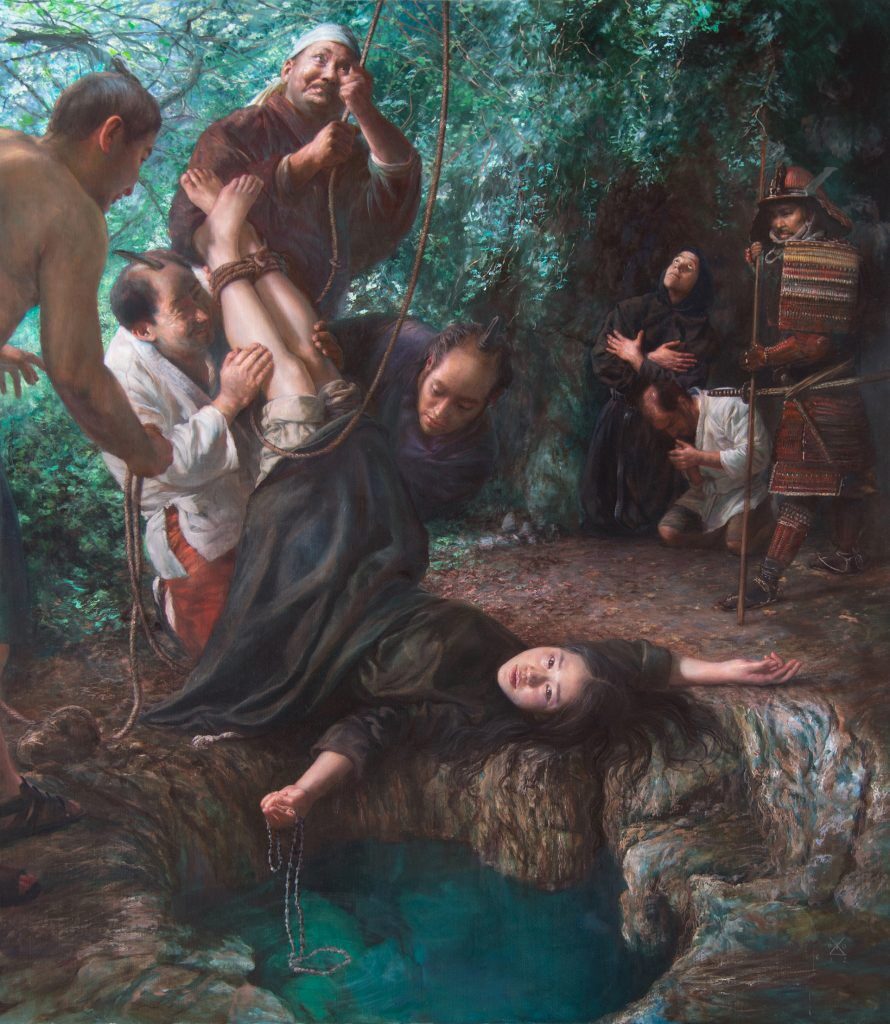
This 140 x 160 centimeter oil on linen depicts the terrible ordeal of the pit suffered by St. Magdalene of Nagasaki, patroness of the Secular Augustinian Recollect Fraternity. The work, located in the General Curia of the Augustinian Recollects in Rome, is located just outside the hall of the General Council, as if accompanying the friars in every decision, reminding them that daily martyrdom and communion with the laity are pillars of a religious family that seeks to proclaim Christ. More than an image, it is a living allegory of martyrdom and of faith as total surrender.
David Conejo, Augustinian Recollect and author of the work, opens with this painting a window into the soul of the Japanese martyr. But he also shares something else: his own vocational journey, his spiritual friendship with Magdalene, and a profoundly theological artistic vision. This is the second time he has depicted her: ” Magdalena and I were the same age: I when I painted her, she when she died. That united me to her spiritually “she confesses. That first meeting was much more than an aesthetic inspiration.
“That first painting helped me to get to know her, to look at her and to let myself be looked at by her. It opened an inner door that I did not expect .”
This second painting is born from that mature and prayerful relationship.
“Painting someone I already know. A spiritual friend who accompanies me along the way. This painting is a tribute, but also a soul-to-soul conversation, an act of love and fidelity. “David explains.
The experience was not only technical: “It has led me to pray more, to learn from her strength and to let her teach me how to look at pain with serenity, without despair..”
Visual allegory of martyrdom
The new work represents an allegory of the martyrdom of Saint Magdalenarich in symbols that speak of the faith she defended with her own life. Far from a mere descriptive scene, the painting is a visual catechesis that associates Magdalene’s suffering with Christ’s passion.
His hands, in a very ancient gesture borrowed from the classical tradition, express the Word and blessingWith this gesture, the saint speaks of Christ, for whom she offers her life, and blesses both the spectator and her executioners. A firm gaze, serene and at the same time sorrowful, sustains the spiritual axis of the whole scene.
On both sides of the composition, the characters surrounding Magdalena express different attitudes towards the suffering of the innocent:
-
On the right is David is portrayed in his Augustinian Recollect habit, evoking the presence of the Fatherevoking the presence of the Father with an elevated gaze and the Holy Spirit in his hands in the form of a dove. At his side, Alexanderthe other author of the work, appears in prayer, facing the soldier in red without eyes. soldier in red without eyessymbol of the Evil One blinded by pride.
-
On the left, three executioners hold Magdalene before the torment: one looks to heaven in search of an illusory good; another, dressed in white and red, represents indifferent cruelty; and the third, in a purple robe, hesitates and opens the door to the conversion of Magdalene. opens the door to conversion.
In a corner, a faceless character represents the spectator: Is the direct invitation to compromise or indifference.. The work interpellates and calls.
Another powerful detail is the well of crystalline waters in which she is to be immersed: not as a reflection of horror, but as a symbol of baptism and the passage from death to life in Christ. baptism and the passage from death to life in Christ.. Finally, in her hand, Magdalene holds a knotted rosary. knotted rosaryevoking her constant prayer and the presence of Mary, Queen of Martyrs, during her passion.
A Legacy for the Order… and for the Church
From the author’s experience, this painting is also a prophecy on canvas a prophecy on canvasa preaching born of the brush, faith and contemplation.
“Every saint must refer us to Christ. Even if he is not painted directly, his presence must be in the painting,” says Friar David.David affirms.
The work is installed in the General Curia of the Augustinian Recollects in Rome. General Curia of the Augustinian Recollects in Romeand has become a reference image for this young saint, lay and martyr, patroness of the Secular Augustinian Recollect Fraternity.Patroness of the Secular Augustinian Recollect Fraternity. It is part of a larger project that seeks to continue to provide a solid and contemporary solid and contemporary iconography to central figures of the Augustinian charism.
A look that crosses time
Of all the characters, only Magdalena stares straight ahead. Her face reflects serenity and pain. The pool – painted as if of clear water – evokes baptism: the martyr, submerged in death, rises to eternal life. In her hand, the knotted rosary, symbol of Mary, Queen of Martyrs, and of the prayers that Magdalene raised to God.
This oil painting, far from being a passive representation of suffering, becomes a visual language that evangelizes. The figure of St. Magdalene of Nagasaki continues to live on in the history of the Order, in the witness of so many lay people who, like her, devote themselves to daily life, and in works such as this one that invite contemplation and conversion.