
The Declaration Gravissimum Educationis proclaimed sixty years ago that “all men, of whatever race, condition and age, have the inalienable right to an education” (GE 1). It was not simply a matter of instruction, but of a path to human fulfillment: “true education should promote the formation of the person… in view of his ultimate purpose and the good of the groups to which he belongs” (GE 1).
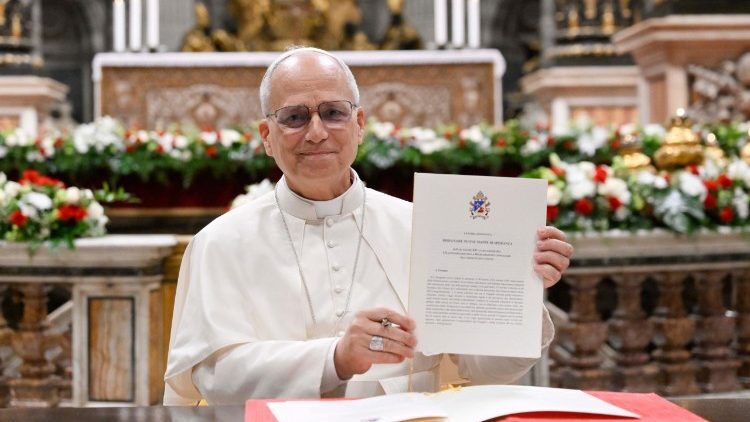
This integral horizon-which embraces body, mind, spirit, society and transcendence-is the same one that Pope Leo XIV today recovers in his apostolic letter Designing New Maps of Hope, signed on October 27, before beginning Mass with the students of the Pontifical Universities. With luminous words, he invites us to rediscover a gaze that does not separate knowledge and life, reason and faith, technique and compassion. “We need an education that makes us look upwards: towards God, towards others, towards the mystery of life,” writes the Pontiff.
In an era marked by digitalization, fragmentation and inner weariness, Leo XIV proposes a real “map” to rediscover lost unity: an education that reweaves the fabric between thought and spirituality, knowledge and meaning, individual and community.
The person at the center: education as wholeness
For the Second Vatican Council, the heart of Christian education is the human person created in the image of God. Gravissimum Educationis expresses it forcefully: “All Christians have the right to an education that helps them to live as a new man in justice and holiness of truth” (GE 2).
 Leo XIV updates this vision by denouncing the “spiritual atrophy” of those who close in on themselves and lose the breadth of their vision. In the face of this, the Pope invites us to cultivate an education that “opens horizons,” that cures the myopia of the soul and restores to the human being the capacity to contemplate the whole.
The integral horizon implies forming not only competent minds, but compassionate hearts, capable of integrating knowledge, ethics, faith and social action. It is an education that looks at the totality of the person and the totality of the world.
 Family, educators and community: weaving hope together
Both documents agree that educating is a shared task. Gravissimum Educationis recalls that parents are “the first and principal educators” (GE 3), and that school, Church and society must cooperate in the same spirit of service.
Leo XIV takes up this idea when he affirms that the classroom cannot be “an abstract intellectual exercise”, but a space where truth becomes life. In an increasingly individualistic and digital society, the Pope invites us to rebuild the educational community as a place of bonds: where learning and loving come together.
Educating for an integral horizon, then, is not the task of specialists, but of entire communities that awaken collective hope and a shared sense of humanity.
A global view of the fragmentation of knowledge
The new cultural context tends towards dispersion. Information is multiplied, but meaning is diluted. Leo XIV warns: “We have become experts in the infinitesimal details of reality, but incapable of recovering a vision of the whole.”
This is where the legacy of Gravissimum Educationis comes in, which called for the integration of “human culture with the message of salvation” (GE 8). Today, this integration translates into rediscovering that Christian wisdom offers a framework of unity in the face of fragmented knowledge.
Integral education does not separate theology and science, spirituality and politics, but places them in fruitful dialogue. Only from this broad vision – that “overall view” that overcomes spiritual atrophy – can a new educational humanism be built.
 Evangelizing by educating: knowledge as service and gift
Gravissimum Educationis affirms that the Church educates because “she has received the mandate to proclaim to all people the mystery of salvation” (GE 1). Christian education is not reduced to the transmission of doctrine, but is a concrete form of evangelization.
Leo XIV expresses it in contemporary language: education is “an act of love that satisfies the hunger for truth and meaning”. In the midst of a world saturated with information and existential emptiness, this mission takes on new urgency.
To educate for an integral horizon means to teach to think, to pray, to create and to serve; to unite knowledge with love, knowledge with charity. Only in this way can education become a path of hope and liberation.
Designing hope with a total look
The letter Designing New Maps of Hope does not replace Gravissimum Educationis: it prolongs and updates it. Both share a profound conviction: only an integral education, rooted in truth and open to the mystery of God, can sustain the hope of the world.
 In the face of today’s challenges – polarization, ecological crisis, inequalities, technification of thought – the Church proposes to look again at the whole, to reconcile the broken parts of the human experience.
To educate, in this sense, is to trace paths of communion. It is to form people who integrate faith and reason, science and compassion, freedom and responsibility. It is to rediscover that authentic knowledge does not enclose, but opens: it opens to the other, to the world, to God.
In the words of Leo XIV: “Education is the art of looking far ahead, of not fearing questions, of overcoming intellectual laziness and defeating spiritual atrophy.”
And in those of Gravissimum Educationis: “That young people may grow up in conformity with the new man, created in righteousness and holiness of truth” (GE 2).
Both voices, separated by six decades, call us to the same thing: to educate for an integral horizon of hope.